Saturday, 28 December 2013

Problems with the current transmedia state: Part 2

In Part 1 of this post I was talking about transmedia storytelling and about how, at least in its current form, it isn't really reaching its full potential.

Here in Part 2 I'm going to try and tackle my issues with current transmedia properties by giving an overview of my own idea for a Harry Potter themed transmedia project.

Firstly, why Harry Potter?

Well; it's a huge franchise already, is built upon a universe which gives great opportunity for expansion and has already crossed over into different mediums: three key points that allow for a new transmedia entity to be successful. (This isn't to say that a new franchise can't attempt the same thing of course, but we're still in relatively early days as far as transmedia storytelling is concerned, and so established franchises are in a better starting position).


Humble beginnings for the 'Harry Potter' film franchise

So, how would my Harry Potter transmedia property work?

It's based upon the idea of combining a video game, a website and a television show to create a cross-platform storytelling experience. Not exactly the idea of telling one story across different mediums, but rather using different mediums to tell multiple stories that all relate to the same world, the same parent property.

It begins with the video game: An MMO game (massively multiplayer online game) set at Hogwarts Castle and the surrounding areas. Each player creates and takes control of a Hogwarts student who can then freely explore the game-world, take part in quests and activities and can interact with other player characters who are all roaming the grounds simultaneously. The game is designed to encourage player to player interaction and offers the players the necessary tools to create their own adventures.


Previous 'Harry Potter' video games have fallen short of fan expectations

The most important feature however, would be the game's 'replay editor'. Similar to previous games who have used the technology (Grand Theft Auto 4, Driver 3 etc.) the game would allow players to view their previous game-play, and use editing tools to cut together a short movie created from their in-game activities. A player could, for example, have a duel with another character and then use the replay editor to turn it into a Harry Potter/Western duel mash-up. The possibilities are limited only by each player's imagination.

That's just the first stage though.

In stage two players would be able to upload their video creations to a specialised website where other players (and people interested in the website only) can watch, comment on and vote for their favourite movies. The system would work much like Lego Cuusoo, whereby popular creations are voted into a review stage, and here's where it gets exciting.

The third stage takes this to another level. The most popular video creations will be judged by a team consisting of creators of the video game and of the Harry Potter franchise. The videos deemed good enough will then be taken and transformed into short cartoons by a dedicated animation team, ready to be broadcast on children's TV networks.


A look at how this 'Harry Potter' transmedia franchise could cross multiple platforms


From video game to children's TV show this process takes one property and expands it beyond traditional media platform boundaries. It puts creativity in the hands of the consumer whilst retaining enough company control to ensure quality content.
Though admittedly ambitious, it is a promising transmedia platform. Not only does it engage and involve audiences through the creation and selection processes, but it also combines the audiences from video games, the internet and television: players can become viewers; viewers can become creators; creators can become judges. The system allows for a level of involvement not yet seen within a transmedia property.

It might not, in this brief overview, be perfect, but what it does is answers some of the problems regarding current transmedia stories. Of course, Harry Potter is just one example, this method could be applied to multiple properties as well as new creations. The important aspects are the combination of video games, the internet and video content to engage and unite audiences.

Tuesday, 24 December 2013

Problems with the current transmedia state: Part 1

As I mentioned in my last post, transmedia storytelling is the process of telling a narrative through multiple mediums and sources; but, how effective are transmedia stories? Do they work as a form of storytelling, do they satisfy the new requirements of multi-screen audiences?

In my opinion, no, they don't - at least not yet. Transmedia storytelling is still a fairly new technique, and like with any new system or process, it takes time to work out just how it can work, and how it can function at its best. Current efforts at transmedia stories are having varied levels of success, but in my mind they aren't reaching their full potential.

I'm going to take a look at two franchises, Defiance and Halo 4, both recent forays into transmedia storytelling that highlight some of the issues with current transmedia efforts.


'Defiance' and 'Halo 4', breaking media boundaries?
Defiance, one of the first properties to be specifically pitched and created as a transmedia franchise, is a Sci-Fi TV show and online multiplayer game that takes place on a future, radically terra-formed Earth, that finds humans co-existing with an alien species.
The show is broadcast on the SyFy channel whilst the game is available across consoles and on PC. Players can watch the show, which develops the story of Defiance, and then play in that same world and meet the same characters that the TV show establishes. The way it works is that events in the show have an effect on the game world, but don't actively effect the players character or goal.

Halo 4 is a first person shooter (FPS) game, the fourth in the Halo Series of videogames. It is now accompanied by Halo 4: Forward Unto Dawn, a web-series (and now full length film) available online, on DVD/Blu-Ray and on Netflix. The film acts as a precursor to events of the game, and its success has led to the creation of Halo: The TV Series, which is currently in development.

The reasoning behind both of these franchises is simple: broaden the audience of a TV show, and of a video game, by bringing the two together. Science Fiction lends itself well to transmedia because the genre itself often creates large fan-bases, and therefore the biggest opportunity for tie-in content and the biggest chance that TV fans will also be gamers, or comic book readers, or web-TV watchers. It's not surprising that Sci-Fi franchises find it easy to make the leap from traditional entity to transmedia property.


Sci-Fi Fandom, the perfect market for transmedia franchises?
My issue with this though, is that by broadening the world of a niche game or TV show you merely adopt the same audience for a different format. Sadly the figures aren't available, but realistically what percentage of Defiance's viewership will be the gamers who invest in the universe? How many non-Halo fans will choose to watch the Halo web or TV series?
Of course, creating one story through multiple mediums is the point of transmedia storytelling – my issue isn't with these franchises attempting to broaden their narrative, it's with their approach. Defiance could have become a gateway for non-gamers to 'experiment' with video games. Halo 4: Forward Unto Dawn could have brought in a new audience to the Halo Series, but sadly because of their marketing and production they merely attract an audience who is already there.

One of the key ways I feel Defiance and Halo 4 have neglected the possibilities of transmedia is through their design. Take a look at the trailer for Defiance below, and also at the comparison shots of Halo 4 and Halo 4: Forward Unto Dawn.


Similarities in the visual styles between halo 4: Forward Unto Dawn and 'Halo 4' the game.

The trailer for Defiance screams 'video game' – everything from the special effects, the character and monster design right down to the dialogue and even the format of the show (which, admittedly, is less apparent in the trailer), is designed to emulate the feel of playing a game.
The same can be said for Halo 4: Forward Unto Dawn; the use of 'Heads Up Display' (HUD) shots in the film are made to copy the HUD you see whilst playing the game. The costume design, the dialogue, and again the format of the film, is all made to seem like a game.

At this stage it seems easy to criticise, but where is the solution? What can be done and why should anything be done? Well, for that you'll have to wait for my next post, in which I'll be answering those questions by giving an overview of my own ideas for a transmedia property centred on the Harry Potter universe.

Thursday, 19 December 2013

What is transmedia storytelling?

Transmedia storytelling is on the rise, with more and more production companies (and industries in general) trying to utilise it within their latest projects. It's possible that transmedia will soon be the prominent form of storytelling and will in fact be the main way in which we as an audience consume and interact with media.

But, what exactly is transmedia storytelling? Where did it come from? Why is it so important?


The 'new' transmedia world


Henry Jenkins, a media scholar who has written extensively about new media cultures, coined the term 'transmedia', describing it as:

"[A] process where integral elements of a fiction get dispersed systematically across multiple delivery channels for the purpose of creating a unified and coordinated entertainment experience. Ideally, each medium makes its own unique contribution to the unfolding of the story."

Essentially, transmedia storytelling revolves around utilising different mediums and formats to tell one story. This isn't to be confused with more traditional media franchises that spawn spin-offs, sequels, reboots and merchandise. The key difference is that transmedia properties tell one story, instead of re-telling or branching out into territories with multiple stories.

Jenkins uses the example of The Matrix franchise:

"[K]ey bits of information are conveyed through three live action films, a series of animated shorts, two collections of comic book stories, and several video games. There is no one single source or ur-text where one can turn to gain all of the information needed to comprehend the Matrix universe."


'The Matrix' 'universe'

 Compare The Matrix with a similar, yet more traditional film franchise, and the distinction becomes more apparent. Sam Raimi's Spider-Man film spawned two sequels, video game adaptations of each film and was based off of an original comic book series. Yet, those video games simply retold the story of the films, and the film storylines themselves were adaptations of the comic book narratives. With each new property the same information was relayed - you could invest in one source and gain all of the needed information.

It won't come as a surprise that transmedia storytelling really took off with the advent of modern media technologies. With technological advancements came the ability to watch film and television on portable devices, the option to play mobile games relating to film and TV properties as you watched and the ability to interact with media properties using apps and interactive websites. Technology changed the way we consume media, and this naturally lead to a new type of storytelling.

Our new 'multi-screen world'


The reason all of this matters really ties together everything I've discussed. In a world of multi-screen viewers the need to engage an audience through interactivity and active involvement is more important than ever. New projects are constantly coming to the fore that try to innovate beyond the usual standard and that try to attract audiences using new, transmedia solutions.

In my next post I will assess just how successful current attempts at transmedia storytelling are, focusing on the Defiance TV show and video game project created by Universal Cable and Trion Worlds, as well as the Halo universe created by Bungie.


'Defiance'; TV show by Universal Cable & video game by Trion Worlds

In the meantime, you can check out Henry Jenkins' blog, as well as his posts on transmedia storytelling:

http://henryjenkins.org/
henryjenkins.org/2007/03/transmedia_storytelling_101.html‎
http://www.henryjenkins.org/2011/08/defining_transmedia_further_re.html

Wednesday, 18 December 2013

The use of sound as a narrative device in video games

Sound in film and video games isn’t something I’ve touched upon before as a narrative device. In all honesty, it’s something of a blind spot in my knowledge of both mediums – sure, I know the methods of recording, mixing and editing sound – but it mostly plays second fiddle to the visual side of things.

Sound does play a crucial role in narrative storytelling though, and it’s important not to forget that it too has evolved and changed over time, especially with the advent of digital recording methods.


Even at a glance the change from analogue to digital is apparent


I stumbled across an interesting article discussing sound within video games compared to film. Whilst it looks at the jump from analogue to digital as well as a general look at the history of sound, what’s more interesting is the elements that focus on how sound has evolved in both mediums creatively and thematically.

It’s well worth a read (if you can forgive the non-native author’s use of broken-English), you can find the article here.

Sound will always be a pivotal part of films and video games, but what's most interesting here is the assertion that sound plays a more active role in the evolution of these mediums and in the development of digital technology.

Monday, 16 December 2013

How video games are transforming the film industry

Here is a very interesting article from The Guardian a few weeks back discussing how, in a stark contrast to popular belief, video games are now changing the film industry:


The main focus of the article is on how video game technology is changing the way movies are produced, with Andy Serkis quoted as saying "[t]here was probably a time when people in the games industry wanted to emulate films, but now it's very much the other way around: the technology is driven by video games".
 

Motion capture technology used in 'Ryse: Son of Rome'

The article also goes into how new video game technologies (specifically the latest generation of consoles) are allowing developers to craft increasingly emotional stories within games, bridging the gap between entertainment and art form. Peter Gornstein (Cinematic Director at developer Crytek) is quoted as saying that new technologies allow developers to overcome the "uncanny valley" - the notion that details within a game rendered improperly cause an unrealistic, creepy feeling. He says that "[t]hat has been a big problem with games in the past. But what we can do now, in real-time, is produce imagery and emotional experiences within a game, at a level where the uncanny valley is left far behind".

Capturing new levels of emotion in 'Ryse: Son of Rome'

It's certainly an interesting prospect, not only showing how the perception of games is rapidly changing, but also how the effect the video game industry is having on other popular media industries is growing immensely.

Saturday, 14 December 2013

Why video games are succeeding where films don't

There’s a great article over at www.fastcompany.com asking the question “why do video games succeed where movies do not?” You can give it a read here:


I won’t go through the article in detail as it pretty much explains the point perfectly itself, but there are some interesting notions in it.

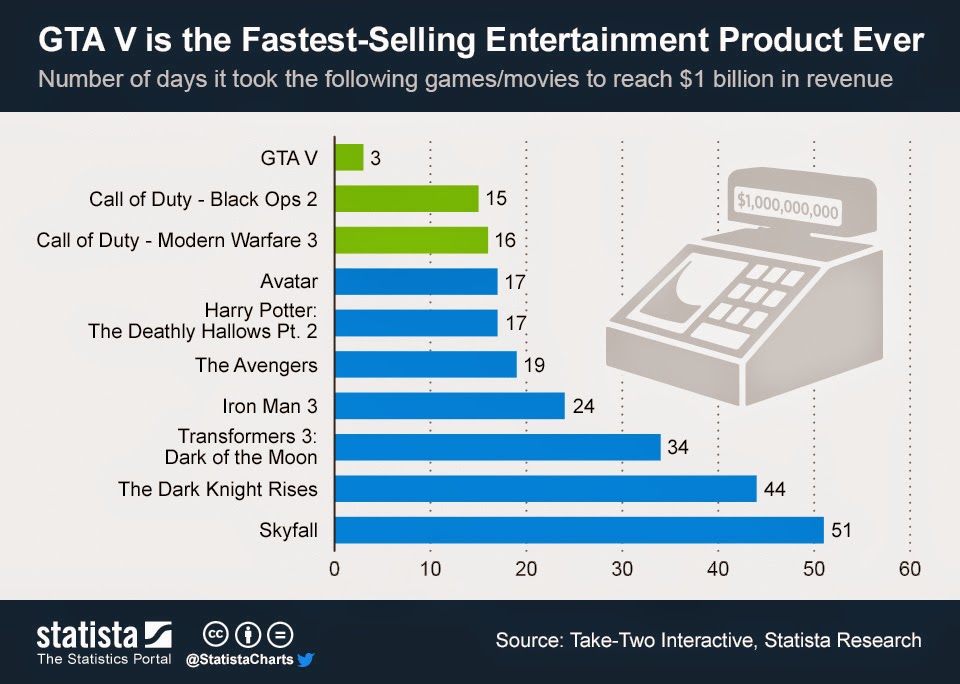
Firstly; the highest grossing video game of all time (GTA V) cost more than almost every movie at a $266 million development cost (Pirates of the Caribbean: At World’s End being the exception) and also had the biggest launch success of any piece of entertainment, taking in $800 million on its first day.

Graph showing the financial success of 'GTA V' compared to other large media releases

Secondly; whilst the video game industry is on the rise, with a projected total growth of $67 billion in 2013 rising to $82 billion in 2017, the film industry hit a $94 billion low in 2010, dropping 17% after inflation from 2001.

Asking why the games industry continues to ascend whilst the movie business remains stagnant, the article picks out a few very interesting points:

First and foremost, as opposed to films now a days, you cannot easily pirate video games. Dedicated consoles, anti-piracy measures and the social aspect of subscription play services make it harder not to pay – sure, it’s a forced moral win, but a win is a win.

Second; video games offer players control over their time and money: play when you want, for as long as you want and spend as much as you want – with cinemas you’re tied into a schedule, and even with home TV you’re chained to the program running time. In this new world of digital content, second screens and social networking, being able to dive in and out of a game for 5 minutes is seemingly a very valuable asset.

Perhaps citing the most important point, the article ends on the opposing treatment of women in both the game and film industries. Video games have embraced the fact that 40% of their audience are women, and as a result have diversified to accommodate this fact. The film industry though, still predominantly targets a younger male audience, failing to recognise the diversity of the actual audience and provide content for it.

Video games are listening to what people want, are making that content and are allowing them to play it whenever they want. The film industry though, remains stubborn (for the most part) and tells the audience what they want to watch, when they want to watch it and how much they should pay for it. It will be interesting to see where this strategy has led them in a decade or so…

Friday, 13 December 2013

The 'Grand Theft Auto' problem

In my last post I began talking about ‘transmedia’, but I’m going to pause on that topic for a bit to talk about Grand Theft Auto 5… mostly because I have just finished it and the story really bothered me!

Grand Theft Auto 5 (GTA 5) has made shockwaves in the video game industry; not only did it make a record-breaking $800 million on its first day but within three days it had surpassed $1 billion in sales worldwide – a feat that most major box office blockbusters would find an impossible task.

'Grand Theft Auto 5' by Rockstar Games

By looking at the reviews these figures seem deserved, GTA 5 received top ratings across the board and was universally praised by critics and players alike. But, having played the game myself, I can’t help but think that Rockstar (the games developer) has gotten off a little easy in some respects.

Sure, GTA 5 is a truly impressive game; the game world is massive, the gameplay mechanics are smooth and the satire for which the series is known for plays out on top form. Where I feel it falls down though, is within Dan Houser’s (Rockstar co-founder and writer for the GTA series) ability to tell a satisfying, character driven narrative within the madness of GTA’s Hollywood blockbuster inspired world.


'GTA 5': Mixing scenic beauty with Hollywood style action

GTA has always been about larger-than-life action, but for the first time in the series Rockstar gave us three playable protagonists to inhabit and run amok with. Houser promised that with this new gameplay mechanic there would come a bigger, more mature and complex narrative that would entwine the separate lives of these characters – Rockstar were clearly aiming to create a deeper experience for the player, and with previous GTA titles falling back on stereotypical action clichés, I was looking forward to this new direction for the series.


The three playable protagonists: Michael, Franklin and Trevor

 But alas, it was an unfounded claim (for the most part).

Houser instead gave us a story that, although able to shine at points with complex character moments, mostly falls back on those clichès that lead nicely onto the next insane mission, rather than give us proper character development.

To illustrate my point I’ll take an example from the last act of the game (spoilers ahead):

Trevor, the maniac of the trio and ex-best friend to Michael (the retired bank robber who faked his own death) has allowed the latter to be kidnapped by Chinese mobsters and slung up on a meat hook for ‘processing’. Luckily, Franklin, the youthful ‘gangbanger’ of our story rescues Michael and soon all returns to normal. For a while Trevor and Michael simply ignore each other; but, play on for a mere 20 minutes more and suddenly the pair are thrust together again with nothing more than a few shouting matches to show their hatred and aggression – I can’t speak for everyone, but if my ex-best friend whom I had faked my own death to escape from had me abducted and nearly killed I would be significantly more angry than that, and I imagine he’d be pretty pissed off too!

Within the world of GTA 5 though, this is the norm! Every cutscene within the game seems to run the same way: characters meet, they argue, someone says “shut up” louder than the other two, and then the mission starts with pally dialogue and not a mention of the characters bigger, more significant emotions or issues. It’s frustrating, increasingly so as the narrative hurtles towards it’s finale in which characters are forced to confront their own demons and choose between life and death (though in all honesty it’s not that dramatic!).


A not so successful mix of character drama and outlandish action?

You may be thinking, “come on, it’s a game, who really cares?” Seeing as this is GTA, a franchise constantly shrouded in controversy and known for lampooning modern culture, you may be right to shrug this off, but I think there’s a key issue with GTA 5 that makes this matter. Houser and the team at Rockstar put a fairly large focus on these characters, their differing backgrounds and their intricate, personal lives – lives that we, the player, watch unfold through our actions.
Essentially, Houser promised us all the sparkly action of a blockbuster movie combined with the more mature character development of a drama. As storytelling becomes a bigger part of video games, and as they try increasingly to learn from and reproduce elements of films, character seems to play a key role.

The problem with GTA 5 is that whilst they tried and whilst they can be applauded for that, they failed to really move away from the explosions and outlandish action of previous entries and so their increased focus on character merely gets lost in the mix, shoved aside to make room for the next gunfight, rather than coming to the fore and giving those gunfights meaning and attachment.